
Vening Meinesz Prize
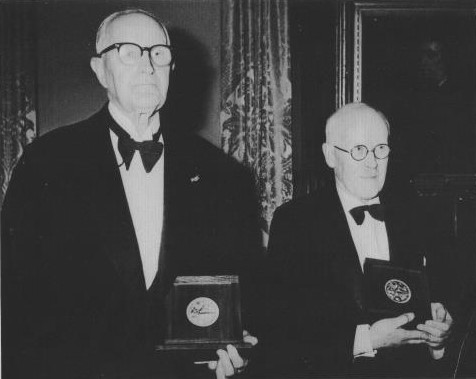
Vening Meinesz (left) with his opponent Harold Jeffreys in 1962 after the awarding of the Vetlesen Medal, the “Nobel Prize” for Earth scientists
From 2024 onwards, the KNGMG awards the Vening Meinesz Prize annually. This personal prize is intended for young earth and environmental researchers. Before 2024, the prize was awarded biennially by NWO.
The prize is named after prof.dr.ir. Felix Vening Meinesz (1887-1966), one of the founding fathers of the Dutch earth sciences and of NWO. He became known for his research of gravity, for which he regularly sailed with submarines of the Dutch Navy. NWO was able to award the prize from his financial legacy. He wanted to use it to encourage promising earth scientists. The KNGMG awards the prize through funding from the Earth and Environmental Sciences Table of the NWO’s Exact and Natural Sciences (ENW) domain.
History
The Vening Meinesz Prize was made possible thanks to a donation made by prof.dr.ir. Felix Vening Meinesz in 1962 to ZWO (‘Zuiver Wetenschappelijk Onderzoek’), the predecessor of NWO. Columbia University, New York, awarded him the first Unger Vetlesen Prize for Earth Sciences in 1962 for his significant achievements in that field. Vening Meinesz donated a portion of the prize to ZWO, on the condition that from the return of the invested capital a prize would be awarded every 3 to 4 years (if possible) to a young practitioner of earth sciences. The Vening Meinesz Prize now consists of a sum of €10,000 plus a certificate. The prize is intended for study-related expenses such as a fieldwork trip or a visit to a (foreign) congress.
Procedure
About six months before the presentation, the current KNGMG board issues an appeal: Dutch earth and environmental researchers can nominate a young colleague. Candidates must have obtained their PhD less than six years ago and be working in the Netherlands. Nominations should include a curriculum vitae with publication list, a justification regarding the reason for nomination, the scientific achievements already made and the expectations the submitter has of the candidate.
The evaluation committee (in a new composition for each award) makes a proposal to the KNGMG Board. The Board takes a formal decision on this nomination. Before 2024, this was done by the Board of the NWO Physical and Natural Sciences domain – previously from 1998 to 2016 by the NWO Earth and Life Sciences Area Board and before that by the Board of the Geological, Oceanographic – and Atmospheric Sciences Foundation (GOA) of NWO.
Since 1998, the award ceremony has generally taken place during NWO NAC, the NWO Dutch Earth and Environmental Science Congress, the annual meeting for all Dutch earth and environmental scientists.
Who was prof. Felix Vening Meinesz?
Prof. dr. ir. F.A. Vening Meinesz was born in 1887 in The Hague / Scheveningen, as the son of the mayor of Rotterdam and later Amsterdam. From 1927 to 1957 he was professor at Utrecht University, teaching geodesy and cartography. From 1938 he was associated with TU Delft with the same teaching assignment. In addition, from 1945 to 1951, he was chief director of the KNMI. Felix Vening Meinesz died in Amersfoort in 1966.x
In 1945, Professor Vening Meinesz made a trip to the United States by order of the government for the purpose of preparing the establishment of ZWO. The government wanted to establish a new system for financing scientific research after the devastation of World War II. Vening Meinesz investigated the merits of American science funding. From 1950 to 1958, he was a member of the Council for ZWO and a member of the board of ZWO.
An important expedition that Professor Felix Vening Meinesz was a voyage in 1934/1935 with the Dutch submarine K18. The voyage around the globe from Den Helder to the Dutch East Indies via America, Africa and Australia lasted 8 months, at that time the longest trip ever by a submarine. Felix Vening Meinesz had lugged aboard a 200-kilogram device to determine the precise shape of the earth and its geoid. The nearly 2-meter tall earth scientist had made uncomfortable trips in the cramped submarines before. A documentary was made about this trip. The expedition with the K18 is part of a heritage project at Wikipedia, storing the dates of several Dutch expeditions.
In 2014, Theo van Hengel wrote a dissertation on Vening Meinesz: ‘The Diving Dutchman – The marine gravimetric research of F.A. Vening Meinesz (1887-1966)’.
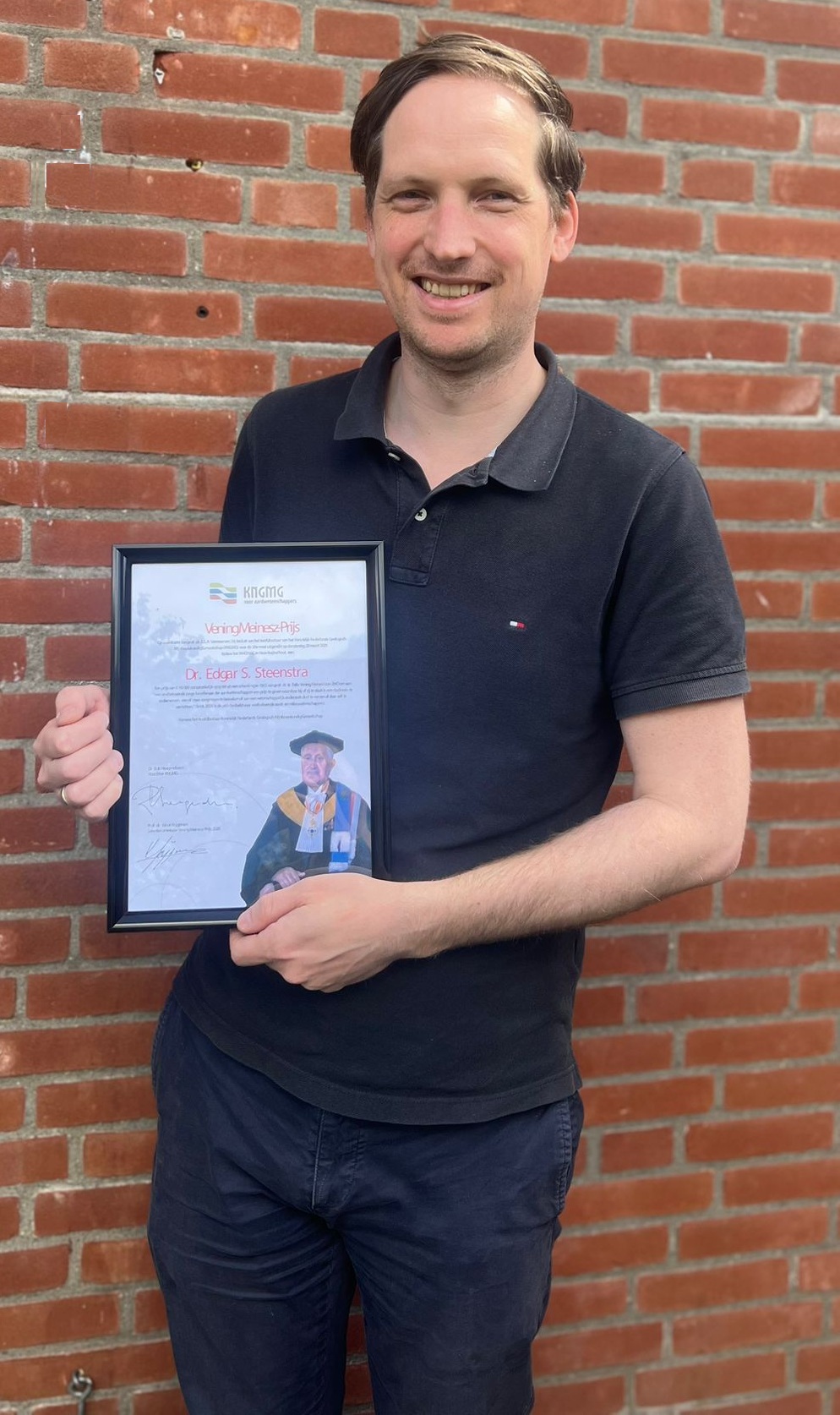
Edgar Steenstra, winner of the Vening Meinesz Price 2025.
Vening Meinesz Prize 2025
Dr. Edgar Steenstra
Dr. Edgar Steenstra is an associate professor at TU Delft. He received his PhD (cum laude) from the VU in 2019 and continued his career with postdoc positions at the Carnegie Institution for Science in Washington D.C. (USA) and with a Marie Curie fellowship at the University of Münster (Germany). Here he studied the chemical processes that took place during the formation of the early Earth and other celestial bodies. He is currently setting up his own research group, made possible by an ERC Starting Grant to establish a laboratory that mimics extreme environments on Venus. This project contributes to the preparations of future ESA and NASA missions to Venus (this research is related to climate research for Earth). He also leads experimental studies on the interaction between lava and planetary surfaces, funded in part by an NWO M-Investment grant. The committee is particularly impressed by this candidate’s high degree of independence and autonomy.
Review committee:
- prof. dr. Wout Krijgsman, chair (UU)
- dr. Peter Kraal (NIOZ)
- mevr. dr. Elly Morriën (UvA)
- dr. Sander Veraverbeke (VU)
- mevr. dr. Renata van der Weijden (UCR & WUR)
The award was received at the NWO-NAC 2025 in Noordwijkerhout.
Lydian Boschman, winner of the Vening Meinesz Price 2024.
Vening Meinesz Prize 2024
Dr. Lydian Boschman
Dr. Lydian Boschman is an associate professor at Utrecht University. In her still early career, she has implemented a number of surprising and innovative ideas creating a new field of study at the interface of geology and biology. She did her earth science study at Utrecht University, as well as her doctoral research on making plate tectonic and paleogeographic reconstructions. She then further developed as a postdoc in the Landscape Ecology Group of the Department of Biology at ETH Zurich (Switzerland) as a biologist. She obtained an ETHZ Postdoc Fellowship to study biology, ecology, and biodiversity at ETH, where she additionally focused on developing quantitative reconstructions of paleogeography – in which topography and bathymetry are to be added to tectonic reconstructions. Drawing on her expertise in both geology and biology, Dr. Boschman was appointed assistant professor at the Department of Earth Sciences in Utrecht on Jan. 1, 2022, where she has established a line of research and teaching in geological development that has led to the current biodiversity hotspots, which is now supported by a Veni grant.
Review committee:
- dr. Lennart de Groot, voorzitter (UU)
- dr. Aafke Schipper (RU)
- dr. ir. Jantiene Baartman (WUR)
- prof. dr. Arjan Hensen (TNO & VU)
- dr. Femke de Jong (NIOZ)
The prize has been awarded at NWO-NAC 2024 in Utrecht.
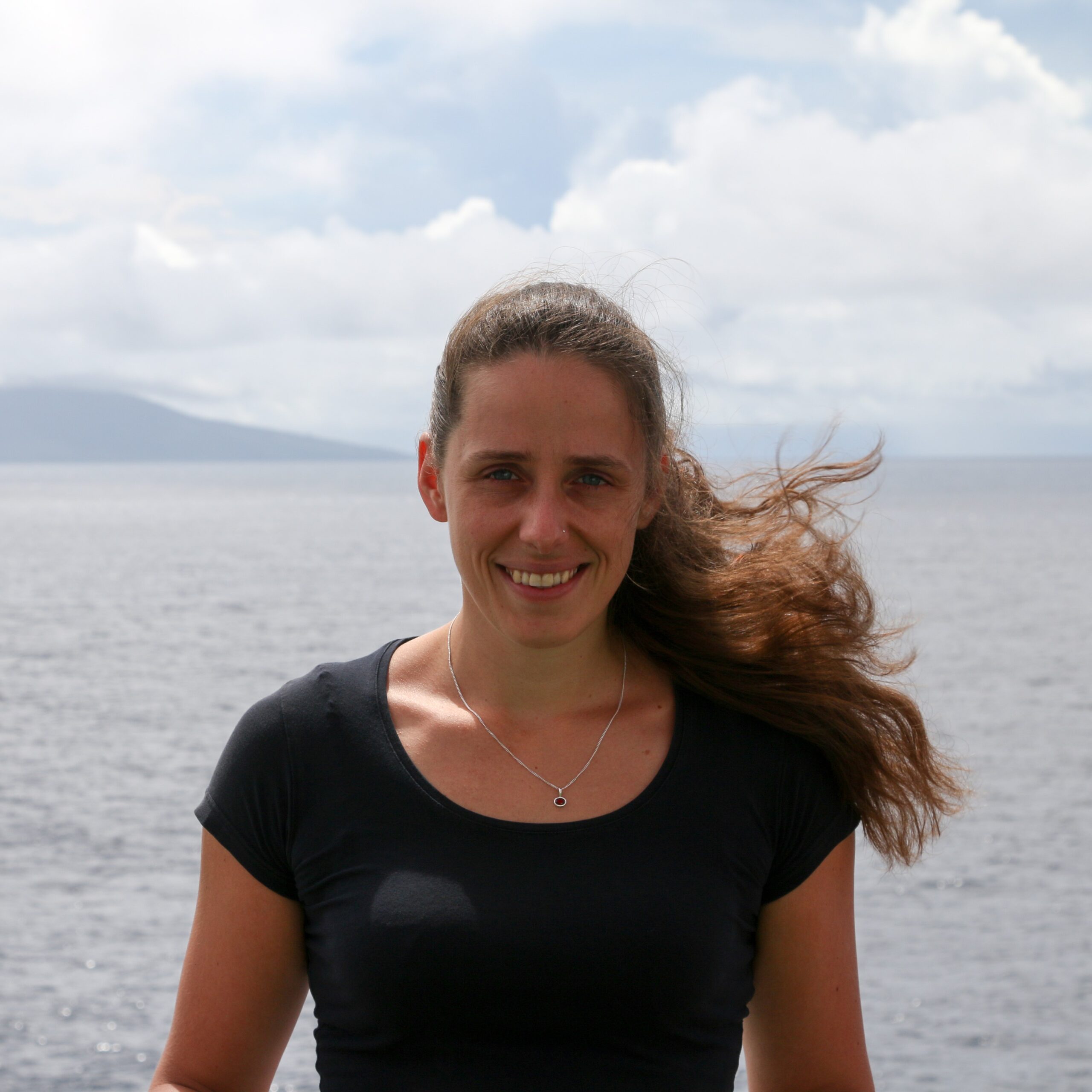
Anoek Beniest, winner of the Vening Meinesz Price 2022.
Vening Meinesz Prize 2022
Dr. Anouk Beniest
The research of dr. Anouk Beniest focuses on plate tectonics. She regularly goes out to the ocean for geophysical and geological research on the Earth’s crust. In particular, back-arc basins have her attention: geological basins on the ocean floor that form where a tectonic plate slides under another tectonic plate, areas of high risk for e.g. earthquakes and submarine landslides. Her skills in the three fundamental pillars of the geosciences, namely geology, geodynamics and geophysics, provide an ideal starting point to lead multidisciplinary projects in geosciences.
In addition to her research Beniest, she has also been committed for years to creating an inclusive, accessible and equal academic environment at the university level, both nationally and internationally. For example, she organized a debate at the European Geosciences Union on bullying in academia.
Review committee:
- Dr. Jorien Vonk, VU (chair)
- Dr. Lennart de Groot, UU
- Dr. Aimée Slangen, NIOZ
- Dr. Riccardo Riva, TUD
Due to residence abroad, Anouk Beniest was unable to receive her award in person at the NAC 2022, therefore this video was recorded.
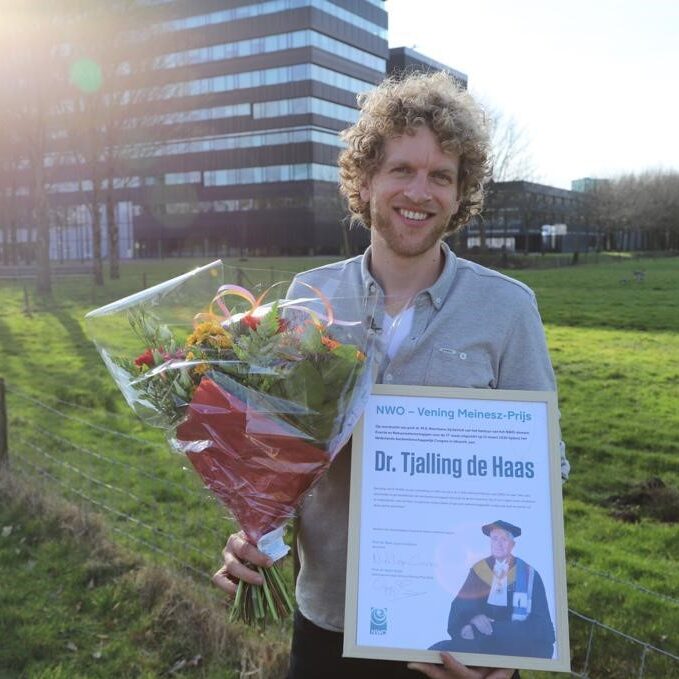
Tjalling de Haas with his certificate.
Vening Meinesz Prize 2020
Dr. Tjalling de Haas
Dr. Tjalling de Haas has independently set up his own laboratory in Utrecht. There he mimics on a small scale processes on mountain slopes such as debris flows, which he can then put into a predictive model. In his mind, he travels effortlessly back and forth between Earth and Mars, between Mars of four billion years and millions of years ago and Earth’s valleys and mountain slopes of today. The question of the occurrence of life on Mars is closely related to the availability of water. Haas found that over the past millions of years, debris flows were active in impact craters. Identical slopes and debris flows occur on Earth, probably even with the same frequency of ice ages and warm periods.
He graduated cum laude at Utrecht University in 2010, where he also received his doctorate cum laude in 2015. Based on satellite images of the surface of Mars, he concluded that there regularly have been periods with liquid water over the past million years. Before that, it was still thought that CO2 gas caused the debris flows on Mars.
He has so far secured two NWO grants: in 2016, a Rubicon grant, which took him to Durham University in England. In 2018, he received a Veni grant. For that, he is seeking answers in two Swiss debris flow regions on the question why one debris flow stays small while another grows into an all-destroying stream.
Review Committee:
- Prof. Dr. Appy Sluis, UU (chair).
- Prof. Dr. Läslo Evers, KNMI & TUD
- Dr. Furu Mienis, NIOZ
- Dr. ir. Gert-Jan Steeneveld, WUR
- Dr. Jorien Vonk, VU
The award ceremony took place on April 8, 2021 during the digital NAC and can be seen in this video.
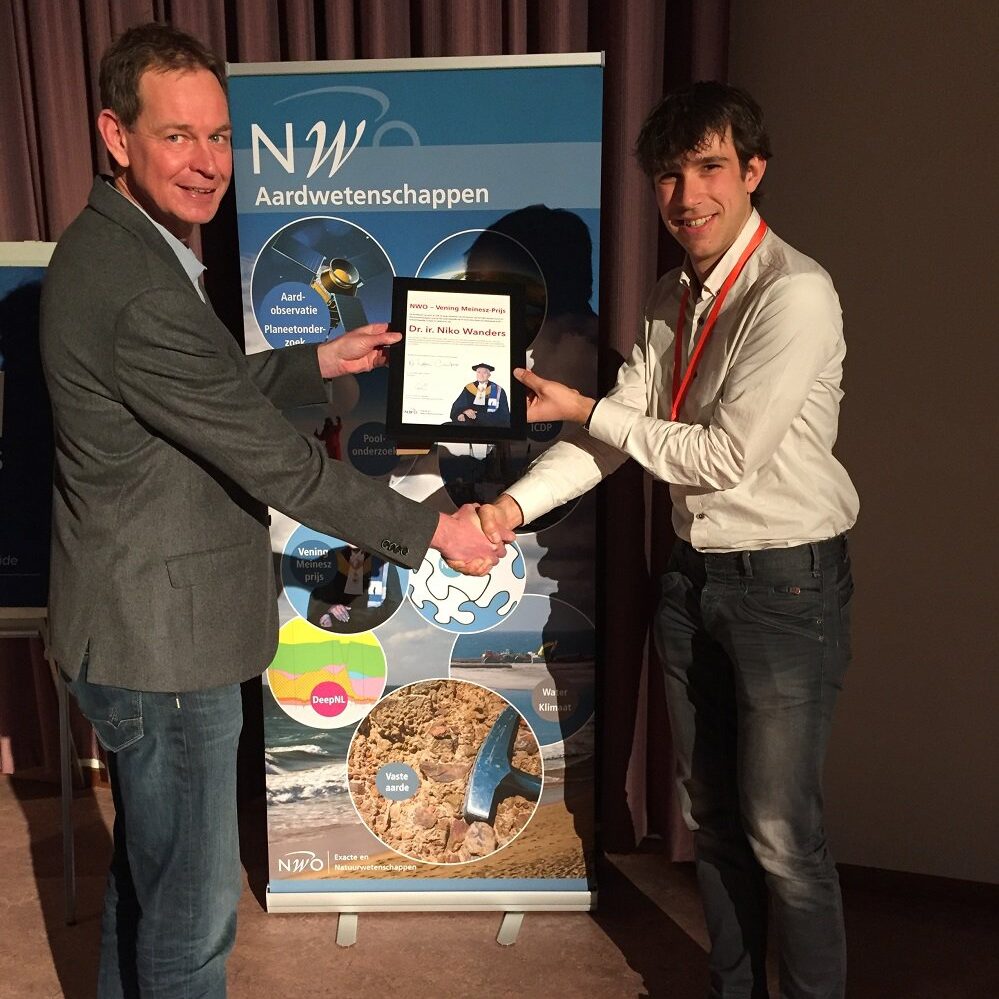
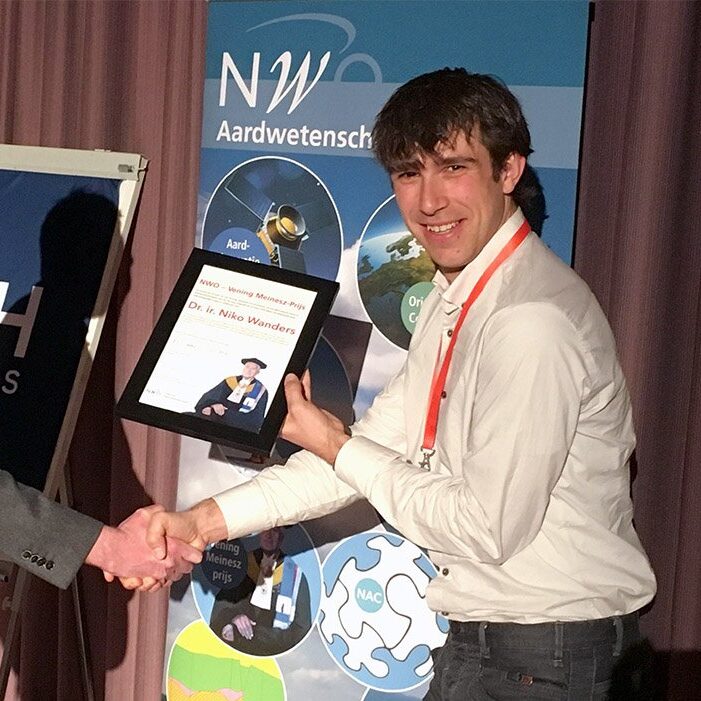
Niko Wanders (right) accepts the prized of the chair of the review committee Guido van der Werf (left).
Vening Meinesz Prize 2018
Dr. Niko Wanders
Flooding and drought in river deltas: that is the research area of dr. ir. Niko Wanders. He obtained his PhD on a study that linked satellite image data to flood models in order to better predict floods. He is currently developing a model using satellite data to understand how people use water reservoirs during droughts. Are there differences in periods of water scarcity or water surplus? In this way, he hopes to determine optimal water management to ensure sustainable water use and minimize water waste in the future. Sufficient clean water for households, industry and agriculture is becoming a major societal challenge worldwide. Climate change is affecting precipitation patterns, creating periods of extremes: droughts and floods. Wanders demonstrated, for example, the added value of satellite observations of soil moisture in predicting flooding in large river systems.
After studying in Wageningen, he received his PhD from Utrecht University. With a NWO Rubicon grant, he worked as a postdoc for two years at the renowned Princeton University (USA). In 2017, he returned to Utrecht with an NWO Veni grant. The decisive factor in winning the Vening Meinesz Prize was that Niko Wanders made his achievements while receiving his PhD barely three years ago.
Review Committee:
- Prof. Dr. Guido van der Werf, VU (chair).
- Prof. Dr. Ramon Hanssen, TUD
- Dr. Esther Stouthamer, UU
- Prof. dr. Jakob Wallinga, WUR
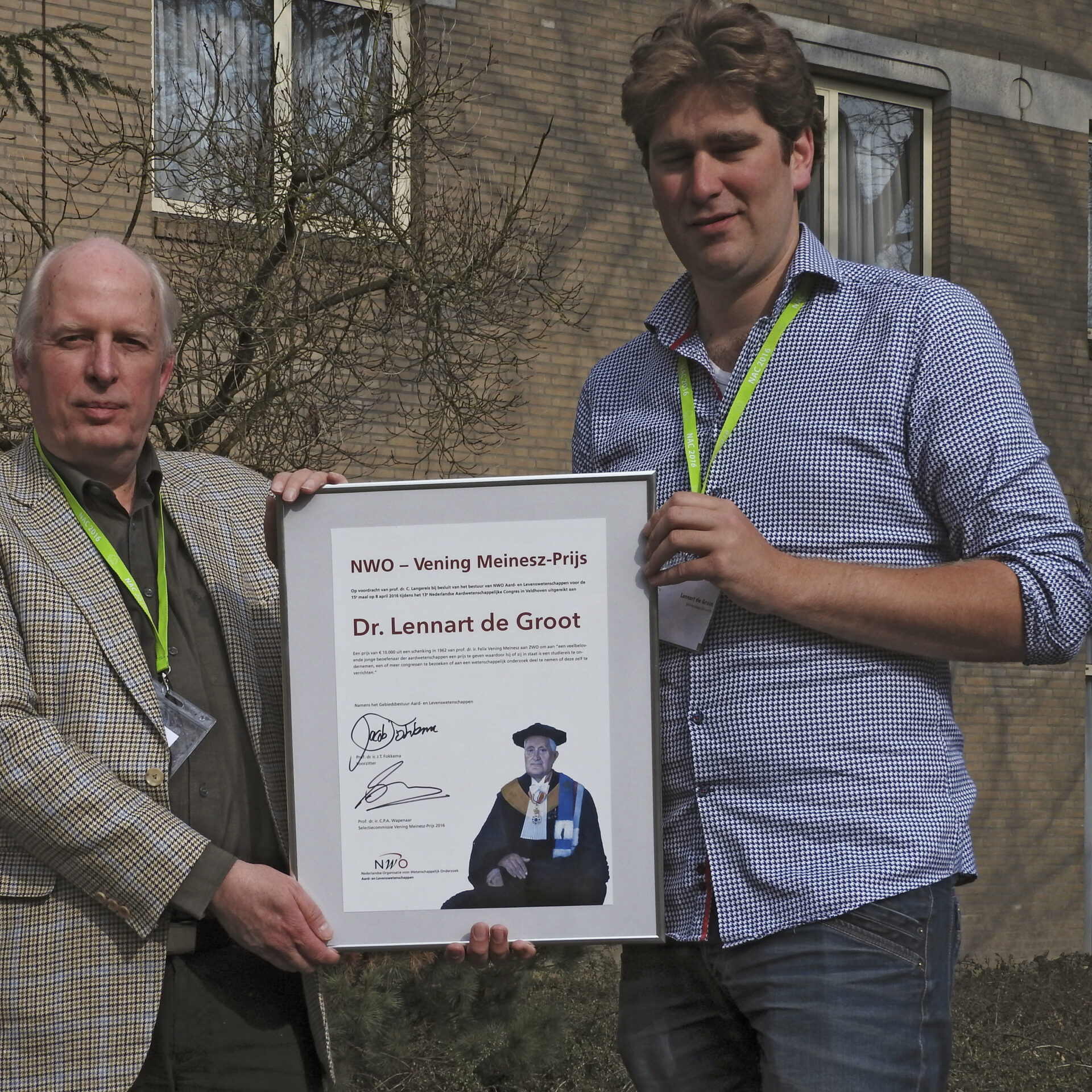
Kees Wapenaar (left) and Lennart de Groot (right) at NAC 2016.
Vening Meinesz Prize 2016
Dr. Lennart de Groot
The Earth’s magnetic field and physical and chemical properties of natural magnetic minerals: this is Lennart de Groot’s field of research. He studies the Earth’s magnetic field, whose strength fluctuates over time and by region. The earth’s magnetic field protects the earth from cosmic radiation. He investigates the geological history using data from volcanic eruptions, where he was able to improve the testing methods. Lennart de Groot received his PhD cum laude and an NWO Veni grant. His research at the remarkable Fort Hoofddijk is explained in the NWO journal Hypothesis (June 2016).
Review committee:
- Prof. Dr. Kees Wapenaar, TUD (chairman)
- Prof. Dr. Paul Andriessen, VU
- Prof. Dr. Freek van der Meer, UT
- Prof. Dr. Caroline Slomp
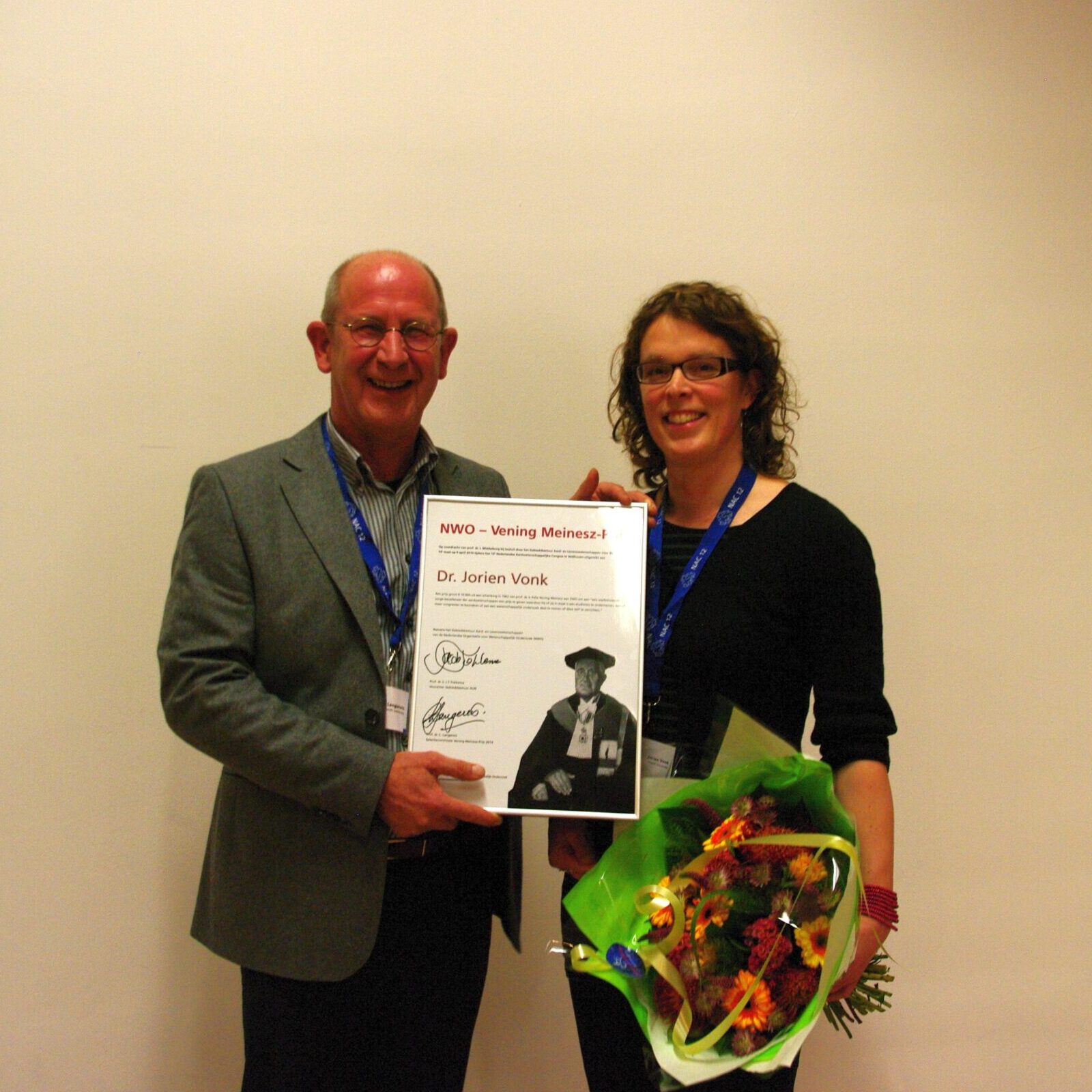
Vening Meinesz Prize 2014
Dr. Jorien Vonk
The impact of thawing permafrost on climate: the research area of the first female winner of the Vening Meinesz Prize. She combines earth science, hydrology and chemistry. Global warming manifests itself mainly in the Arctic. Her particular interest is Yedoma, a form of permafrost that resembles frozen peat. When it thaws, organic material ends up in the environment.
At NWO, she secured a Rubicon and Veni grant, and after winning the VM prize, among others, an ERC Starting Grant. When she won the prize she was affiliated with the UU and the RUG; since 2016 she is Assistant Professor at the VU. The committee was particularly impressed by her independence and autonomy as a researcher, which is reflected in a great experience abroad.
Review committee:
- Prof. Cor Langereis, UU TUD (chairman)
- Dr. Giovanni Bertotti, TUD
- Dr. Guido van der Werf, VU
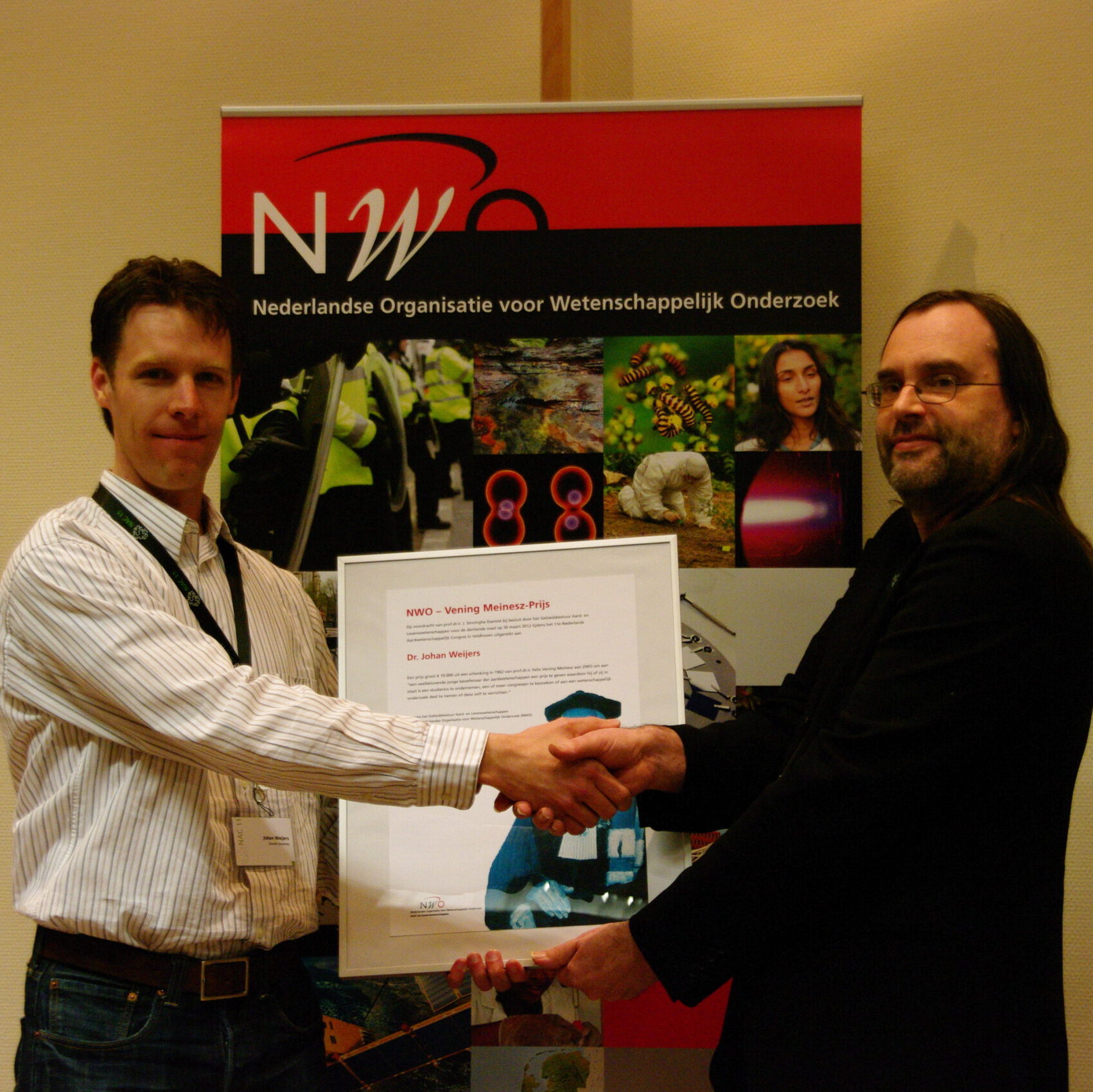
Vening Meinesz Prize 2012
Dr. Johan Weijers
This scientist in organic geochemistry researched fat substances in marine sediments. He developed a new method, a primordial thermometer, useful in global reconstruction of temperature changes.
He received his PhD cum laude, secured an NWO Rubicon and Veni grant and an EGU Young Scientist Award. At the time of winning the VM prize, Weijers was at UU; since 2012, he has worked as a senior researcher at Shell.
Review committee:
- Dr. Bert Vermeersen, TUD (chairman)
- Prof. Jeannot Trampert, UU
- Dr. Wim van Westrenen, VU
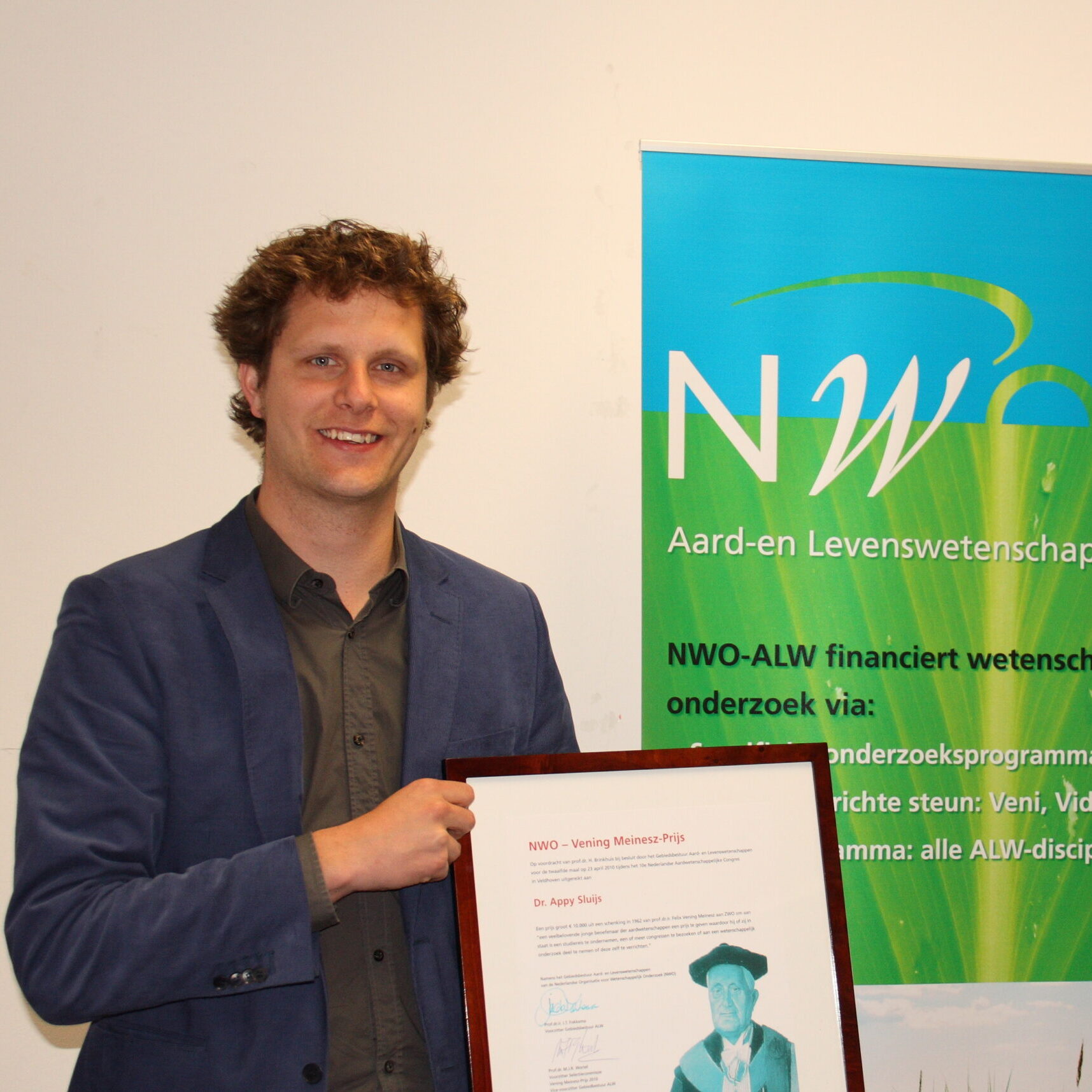
Vening Meinesz Prize 2010
Dr. Appy Sluijs
This climate researcher researches and reconstructs the natural variations of past climate partly from fossil algae remains. Several times he was allowed to join the prestigious IODP drilling expeditions. He showed that a greenhouse world existed 55 million years ago, with palms near the North Pole. His work showed the link between CO2 concentrations in the atmosphere and changing temperatures on Earth. Appy Sluijs is also very active in the fields of education, communication and the contribution of scientific research to public and political debate. He received his PhD cum laude and obtained a Veni grant from NWO. In 2014, he was appointed professor of paleoceanography at UU and received an ERC Starting Grant. He was also part of the Young Academy of the KNAW.
Review committee:
- Prof. Rinus Wortel, UU (chair).
- Dr. Bert Vermeersen, TUD
- Prof. Dr. Jaap Sinninghe Damsté, UU NIOZ
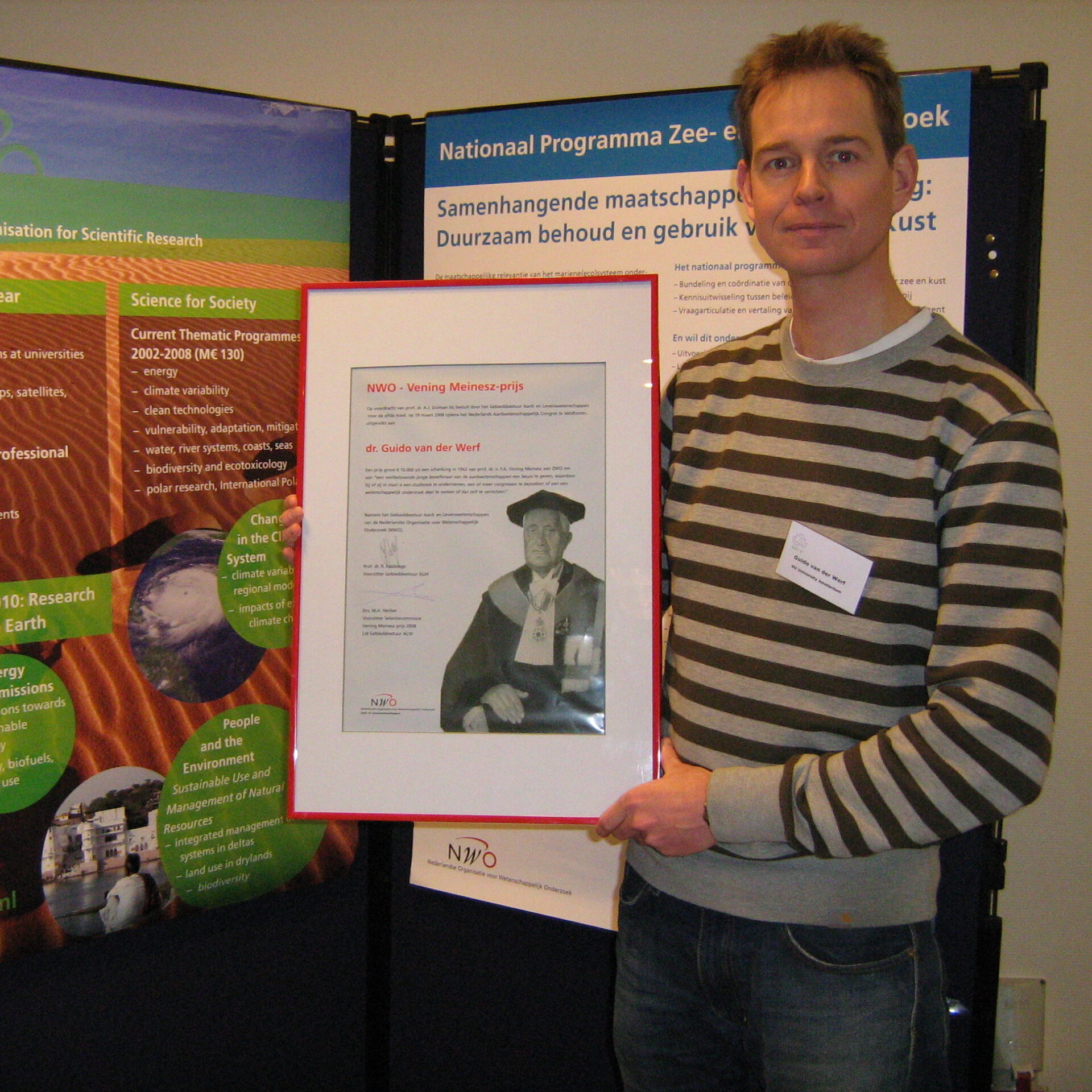
Vening Meinesz Prize 2008
Dr. Guido van der Werf
The research of this physical geographer focuses on the role of forest fires and deforestation in greenhouse gas emissions, and the relationship between climate and deforestation. He used both biogeochemical models and fire detection information from satellites, supplemented by atmospheric models. His data research has allowed a better understanding of the contributions of forest fires to elevated atmospheric greenhouse gas concentrations. He has been a professor at the VU since 2015. In 2016, he received the highest grant within the Renewal Impulse, the Vici, from NWO. He previously received an ERC Starting Grant.
Review committee:
- Prof.drs. Rien Herber, Shell/NAM (chairman)
- Prof. Kees Wapenaar, TUD
- Dr. Esther Stouthamer, UU
- Dr. Giovanni Bertotti, VU
- Prof. Dr. Tom Veldkamp, WUR
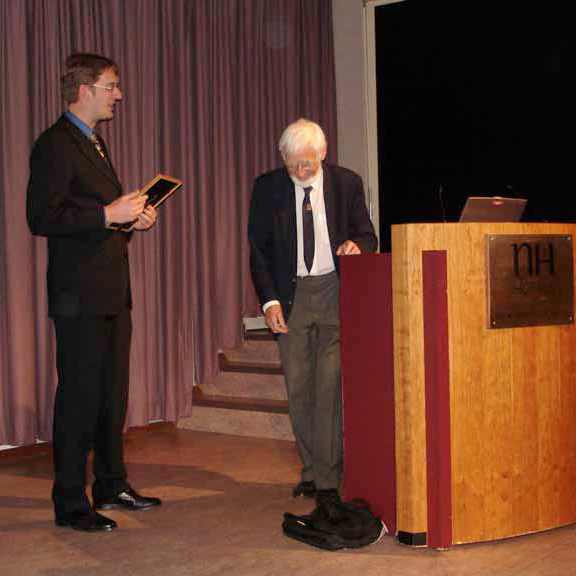
Vening Meinesz Prize 2006
Dr. Wim van Westrenen
The properties of rocks in the interior of planets, that is the research area of petrologist Wim van Westrenen. He studies how the properties and compositions of solid and partly molten rocks change when pressure and temperature are altered. This provides knowledge about, for example, the genesis of planets or the formation of magma that leads to volcanic eruptions. He has been a professor of planetary evolution at the VU since 2013. From NWO, he received a Vidi and Vici grant, among others.
Review committee:
- Prof. Dr. Olaf Schuiling (chairman)
- Prof. Dr. Sierd Cloetingh, UU
- Prof. dr. Nico van Breemen, WUR
- Prof. dr. Stefan Luthi, TUD
- Drs. Rien Herber, Shell/NAM
Vening Meinesz Prize 2000
Dr. Wout Krijgsman
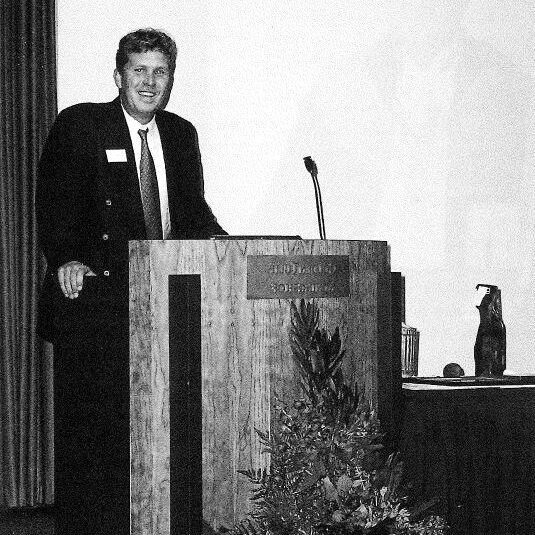
Because of NWO’s 50th anniversary, there was an additional Vening Meinesz Prize in 2000. Wout Krijgsman of the paleomagnetics laboratory at Utrecht University received this prize from Prof. Dr. W. Harder, chairman of the Area Board ALW. He received the prize, among other things, for his research on the Messinian Crisis; during that period the Mediterranean Sea partially dried up due to the closure of the Strait of Gibraltar. He is currently professor of magnetostratigraphy at the UU. From NWO he received, among other things, a Vici grant.
Review committee:
- Prof. Dr. Wolfgang Schlager, VU (chairman)
- Dr. Hessel Speelman, TNO
- Prof. Dr. Rinus Wortel, UU
Vening Meinesz Prize 1998
Dr. Frédéric Marin
Frédéric Marin studied paleontology and worked as a postdoc from 1994 to 2001 at the Institute of Chemistry at Leiden University, in Peter Westbroek’s biogeochemistry group. His research on the biochemical background of calcium formation in organisms (Metazoa) such as mussels and corals branched out in all directions. He worked for two years for the company IsoTis (Bilthoven), specializing in bone and cartilage implants. In 2003, the CNRS attracted him, to the Université de Bourgogne in Dijon (France). He is currently research director of the Biogéoscience Unit at the CNRS and is mainly concerned with shell biomineralization.
Vening Meinesz Prize 1989
Dr. Roel Snieder
Roel Snieder, with a background in theoretical physics, received his PhD cum laude from Utrecht University in 1987. His theoretical research within the field of seismology focuses on the description of the propagation of elastic waves through the earth. From NWO, he received a PIONIER grant in 1991. He is now a professor at the Colorado School of Mines (Golden, USA) and is still doing committee work for NWO.
Vening Meinesz Prize 1983
Dr. Guust Nolet
Guust Nolet received his PhD cum laude in 1976 in Utrecht, the Netherlands, where he developed the first network of portable, digital broadband seismographs and where he became a professor in 1985. His research concerns mainly the inversion of massive amounts of data to localize anomalies in the mantle (seismic tomography) and the influence of diffracted energy on the duration of seismic waves. Starting in 1991, he first imaged a large number of thermal excitations (“plumes”) at Princeton. More recently, his interest is in the thermal history of the Earth and the need to image excitations with greater precision by recording seismograms in oceanic regions. To this end, he accepted a third professorial post in Nice in 2008, where he developed robots that function as undersea seismographs. He is now the George J. Magee Professor of Geophyics, emeritus, at Princeton (U.S.) as well as emeritus at Nice (France), and Adjunct Professor of Geophysics at the Southern University of Science and Technology in Shenzhen (China). He is a member of the American Academy of Arts and Sciences, the Academia Europaea and corresponding member of the KNAW.
Vening Meinesz Prize 1976
Dr.ir. Nico van Breemen
Nico van Breemen (tropical soil science, Agricultural College, 1968) earned his doctorate on chemical processes and conditions in acid sulfate soils (‘katteklei’) in Thailand. He received the Vening Meinesz Prize in 1978 from Mr. W.F. de Gaay Fortman, chairman of ZWO, because at the time of award he was doing research on rice culture in the Philippines. As a postdoctoral fellow at the International Rice Research Institute, he researched ‘problem soils’ for rice cultivation in Southeast Asia. Back in Wageningen in 1981, he stumbled upon the deposition of ammonia from the bioindustry in forests and natural areas: one of six completely accidental discoveries in his research career. Since 1986 Nico van Breemen was professor of soil formation and ecopedology at WUR. On his retirement as a professor in 2004, he therefore concluded that truly new scientific insights almost always rest on serendipity: ‘Today I am going to discover something completely new and yet I am so curious to know what it will be.’ Since 2004, he has been active as a modern art gallery owner.
Vening Meinesz Prize 1972
Dr.ir. Hans Schouten
Hans Schouten is a marine geophysicist. He received his doctorate in geophysics from UU in 1970 and then worked on seismic research in the North Sea, North Atlantic and Caribbean Sea. He received the award together with Ben Engelen from Prof. Dr. W.C. van Unnik, chairman of ZWO, at the Vening Meinesz Laboratory in Utrecht. At the oceanographic research institute Woods Hole Oceanographic Institution (WHOI) in the U.S., he researched such topics as geomagnetism, plate tectonics and mid-oceanic ridges.
Vening Meinesz Prize 1972
Dr. Ben Engelen
In 1963, Ben Engelen received his doctorate cum laude from UU; he conducted research on alpine mountain formation under the influence of gravitational tectonics, focusing on the unique geological genesis of the Dolomites in northern Italy. In 1970, with a ZWO stipend, he stayed as a visiting professor at the Engineering Research Center of Colorado State University in Fort Collins, USA. In 1974, he became a professor of hydrogeology at the VU. He developed into an expert in groundwater flows. Ben Engelen is best known as the founder of regional hydrologic system analysis. Based on this method, land-cover maps of groundwater flow systems in the Netherlands were made in the 1990s
Vening Meinesz Prize 1968
Dr. Hans Zijderveld
Hans Zijderveld received the prize from Prof. Dr. J.N. Bakhuizen van den Brink, chairman of ZWO, for his great achievements in the field of paleomagnetism. He started the Fort Hoofddijk paleomagnetic laboratory in 1963, when the Utrecht university campus De Uithof did not yet exist. Zijderveld published in 1967 a method to better visualize paleomagnetic directions; these figures are still often called “Zijderveld diagrams. Zijderveld was professor of paleomagnetism at UU and, until his retirement in 1995, the head of Fort Hoofddijk, the oldest active paleomagnetic lab in the world.
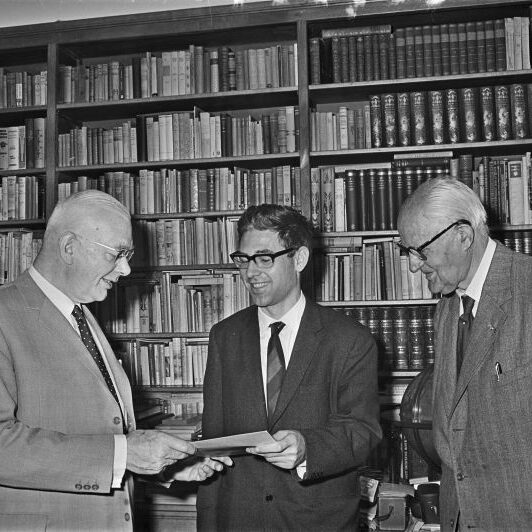
Awarding of the very first Vening Meinesz Prize to Dr. R.D. Olaf Schuiling (center in photo) by Prof. Dr. J.N. (Jan) Bakhuizen van den Brink (left) on Aug. 17, 1965. The award was awarded at the home of prof. Felix Vening Meinesz (right).
Vening Meinesz Prize 1965
Dr. Olaf Schuiling
Olaf Schuiling received his PhD cum laude at Utrecht University in 1961. From 1972 to 1997 he was professor of geochemistry at the UU, in addition to holding numerous ancillary positions. In the period until his retirement in 1997, Schuiling played a crucial role in the development of the field of geochemistry at Utrecht University. He is a pioneer in the field of accelerated weathering of the mineral olivine. In 2009, he founded the Olivine Foundation. In 2017, he wrote the book ‘Olivine, the philosopher’s stone’ with a large number of applications of using olivine to curb climate change. For several years, UU has had the Professor Olaf Schuiling Fund, which enables additional research and education in the field of geochemistry. Olaf Schuiling died in Bilthoven on December 19, 2021.